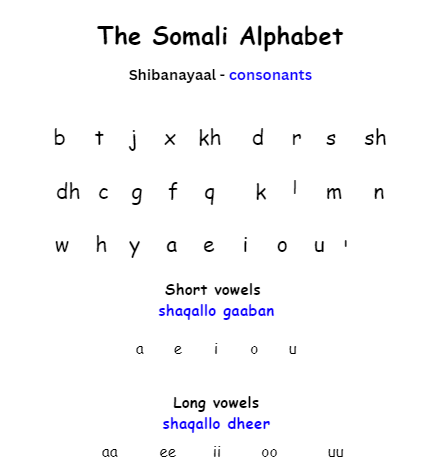
Somali uses the same Roman alphabet as English, but a handful of letters make sounds English speakers have never had to make before. Here’s what each one is, how to say it, and how to practise it with your child.
One of the first things parents notice when they start teaching their child to read Somali is how ‘straightforward’ most of it is. The alphabet is Roman, just like English. There are 26 consonants and 10 vowels (5 short, 5 long), and once a child knows the letters and sounds, they can read almost any word by simply sounding it out — no confusing spelling rules, no silent letters, no “why isn’t this pronounced the way it’s written.”
But a small handful of letters trip people up, because they represent sounds that simply don’t exist in English. If you grew up speaking mostly English yourself, or you’re supporting a child who is more comfortable in English than Somali, these are the sounds worth slowing down for.
The letters Somali doesn’t use
Before getting to the tricky ones, it helps to know what’s ‘missing’. Somali doesn’t use P, Z, or V at all. If your child asks why a word doesn’t look the way an English word might, that’s often the reason — those three letters simply aren’t part of the Somali alphabet.
The sounds that need extra practice
J makes a “ch” sound, not the soft English “j” sound in “jam.” Think of the word ‘jiir’ (rat) — it starts closer to “ch” than to the English J.
X is a glottal sound, similar to an English H, but produced from the back of the throat rather than the front of the mouth. You can hear it in ‘xadhig’ (rope). A useful way to practise this with a child is to have them say “h” while gently tightening the back of the throat — it should feel more effortful than a normal H.
C is an “a” sound produced from the back of the throat. It appears in ‘caano’ (milk). This one often takes the most repetition, because there’s no equivalent gesture in English at all — it’s worth using audio alongside any written practice so your child can hear it repeated rather than guessing from the spelling.
Kh is a digraph — two letters representing one sound — and it’s a “k” sound made from the back of the throat, similar to the “ch” in the Scottish word “loch” or the German “Bach.” You’ll hear it in ‘khamiis’ (a man’s robe).
Dh is the other digraph worth knowing. It’s produced with the tongue striking the roof of the mouth, a little further back than an English “d.” It appears in ‘dhar’ (clothes).
Q is a similar sound to the English “k” sound but is produced further back in the throat.
How to practise these sounds at home
You don’t need to be a fluent Somali speaker yourself to help your child with this — you mostly need repetition and audio.
– Start with flashcards. Seeing the letter and hearing the sound together, repeatedly, builds the connection faster than reading alone.
– Use audio, not just text. These sounds are genuinely hard to learn from a written explanation (including this one) — hearing them said aloud, several times, matters more than reading a description of tongue position.
– Play matching games. Matching sounds to letters, or letters to pictures of the example words above, turns practice into something a young child will actually enjoy repeating.
– Don’t rush past them. It’s tempting to move on once a child can recognise most of the alphabet, but the five sounds above are the ones most likely to get flattened into their nearest English equivalent if they’re not practised deliberately early on.
Once your child is comfortable with these sounds, reading becomes genuinely easier than in English — Somali words are literally just their sounds put together, with no irregular spelling to memorise.
Where to practise
The [Phonics page](https://ashaalinoor.com/how-to-pronounce-the-sounds/) has audio for each of these tricky sounds, so your child can listen and repeat rather than relying on written description alone. Once the sounds feel familiar, Alfabeetada Af Soomaaliga (The Somali Alphabet) and Xarfaha Af Soomaaliga are good first books to put the letters into practice, and the [Parents page](https://ashaalinoor.com/how-to-teach-your-children-somali/) has a fuller walkthrough of how to sequence learning from sounds to first words.