
Culture and Tradition: Why Language Carries More Than Words
Somali is often called a language of poets — for centuries, culture, history and identity were passed down almost entirely through spoken word. Losing the language risks losing more than vocabulary; it risks losing the stories, proverbs and traditions carried inside it.
Somali language is important not just for communication, but to pass on culture and traditions to our children. That’s a simple sentence, but it holds a lot — because for Somalis, language has never just been a tool for getting things done. It’s the vessel culture travels in.
A nation of poets
Somalia is sometimes described, both by outsiders and by Somalis themselves, as a “nation of poets.” For much of Somali history, there was no widely used written script, so poetry, proverbs and oral storytelling carried the weight that books and written records hold in other cultures. Genealogies, historical events, moral teachings and even political disputes were composed and remembered in verse — a skilled poet held real social standing, and a well-turned line of poetry could settle an argument or shift public opinion in a way few other things could.
This is part of why teaching a child Somali is about more than vocabulary. A child who only speaks English can still learn *about* Somali culture second-hand — but a child who understands Somali can encounter that oral tradition directly: the rhythm of a proverb, the wordplay in a poem, the specific phrase an elder uses that doesn’t translate cleanly into English at all.
How old is the Somali language, really?
The honest answer depends on whether you mean spoken or written Somali — and the gap between the two is genuinely striking.
As a spoken language, Somali’s roots go back thousands of years. It belongs to the Cushitic branch of the Afroasiatic language family, and linguists trace its origins to Proto-Cushitic speakers who migrated into the Horn of Africa in waves, beginning many centuries before the modern era. By any measure, Somali is an ancient language.
As a written language, the story is completely different. Somali only gained an official, standardised writing system in October 1972, when the government adopted a Latin-based alphabet developed by Somali linguists, followed by a nationwide literacy campaign to teach it. Various earlier attempts existed — Arabic script had been used for religious and administrative writing for centuries, and a Somali-specific script called Osmanya was invented in the 1920s — but none of these became a widely adopted, standard system the way the 1972 Latin alphabet did.
This means Somali spent almost all its long history as a purely oral language. That’s not a gap in the culture — it’s exactly why poetry, proverbs and storytelling carried so much weight, as covered above. For centuries, oral tradition wasn’t a supplement to written record-keeping; it was the record-keeping. A single generation of Somali speakers alive today has seen the language go from having no standard
The aqal: a tradition built into daily life
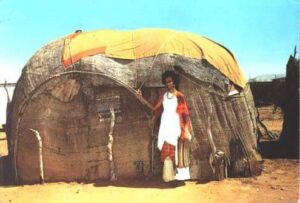
The image often used to represent traditional Somali life — a dome-shaped, portable hut called an aqal — reflects the nomadic pastoralist life that shaped much of Somali culture and, with it, much of the language itself. Historically, Somali herding communities moved with the seasons in search of grazing land and water, and the aqal was built to be taken apart, carried, and rebuilt wherever the family settled next. Words for livestock, weather, land and movement are woven deeply into everyday Somali speech as a result — vocabulary shaped directly by a way of life, not just an abstract set of terms to memorise.
Proverbs: culture in a single sentence
Somali proverbs are still used constantly in everyday conversation, often by grandparents and elders, and they carry an economy of meaning that’s hard to replicate in translation. A single short saying can carry a full lesson about patience, honesty, or family loyalty — the kind of thing that might otherwise take a parent several sentences to explain directly. Children who grow up hearing these proverbs in Somali absorb both the language and the values inside it at the same time.
Why this matters for bilingual families
None of this means a child needs to become a poet or a folklorist to stay connected to their heritage. But it does mean that language and culture aren’t really two separate things to teach — they arrive together, or they don’t arrive fully at all. A child who can follow a Somali proverb, understand the words in a family folk tale, or ask a grandparent a question directly in Somali is connected to their culture in a way that translation alone can’t fully replace.
This is part of why storytelling matters so much in Asha’s own bilingual books — tales like Xijaab Cas iyo Waraabahii (Red-Hijab and the Hyena carry forward the same oral storytelling tradition, just written down and paired with English so today’s diaspora children can access it too. Passing on the language is, in a very real sense, passing on the culture itself — one story, one proverb, and one conversation with a grandparent at a time.
To keep building that foundation at home, explore the full collection of bilingual books – https://ashaalinoor.com/bilingual-books/ or the free Somali learning resources – https://ashaalinoor.com/learn-somali/